Register-Based Census Architecture & NSO Modernisation
Design, implementation, and transition to modern register-based census systems — establishing the administrative data foundations required for advanced AI and statistical computing.
A register-based census is a modern approach to population and housing censuses that relies on administrative and statistical registers rather than traditional field enumeration. This approach enables national statistical offices to produce high-quality census results with lower costs, reduced respondent burden, and more frequent updates.
A register-based census uses existing administrative data sources such as population registers, civil registration systems, tax records, education databases, and other administrative registers as the primary source of census information. The design and implementation of these foundations are typically supported through register-based systems consulting, where administrative data integration, unique identifiers, and quality frameworks replace large-scale field enumeration.
Benefits of Register-Based Census Systems
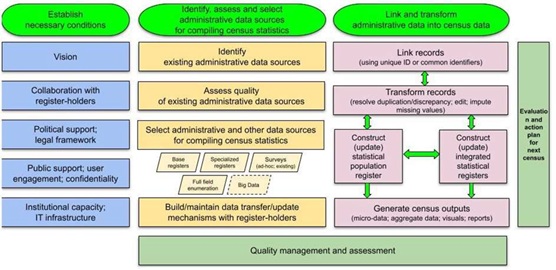
Transition from Traditional Census to Register-Based Census
The transition to a register-based census is a multi-year process requiring institutional readiness, legal frameworks for data sharing, technical infrastructure, and methodological development. Most countries adopt a phased approach combining traditional census methods with administrative data sources.
Quality Assessment & Official Statistics Standards
Quality assessment in a register-based census focuses on evaluating the fitness of administrative data for statistical use across all stages of production. This includes systematic assessment of source quality, data integration and linkage processes, and the accuracy, coherence, timeliness, and comparability of census outputs. Continuous quality monitoring, supported by metadata, coverage analysis, and consistency checks across registers, is essential to ensure that results meet official statistics standards and maintain trust in census outcomes.
International Standards and Best Practices
Register-based census systems are promoted by international organizations such as the United Nations and Eurostat. EnStatX aligns national implementations with these frameworks while adapting them to country-specific legal and administrative contexts.
Key International References
-
UN Handbook on Registers-Based Population and Housing Censuses
The United Nations’ authoritative methodological handbook on register-based population and housing censuses, covering administrative data sources, register integration, quality management, and international best practices.
-
UNECE / Eurostat Guidelines on the Use of Registers and Administrative Data for Population and Housing Censuses
Joint UNECE and Eurostat methodological guidelines providing practical recommendations for register-based and combined census models, including legal, institutional, and technical considerations.
-
Eurostat – European Statistical System Guidelines for Population and Housing Censuses
Official Eurostat guidelines used by national statistical offices within the European Statistical System, covering register-based and combined census approaches, quality requirements, and implementation practices.
What the 2020 Census Round Confirms
Source: ECE/STAT/TM/2026/1 — Measuring Population and Housing: Practices of UNECE Countries in the 2020 Round of Censuses, United Nations, 2026. Published under CC BY 3.0 IGO.
Register adoption is now the majority
In the 2020 round, 33 out of 52 UNECE countries used registers either fully or in a combined design — up from only 19 in 2010. The UNECE report confirms this as a sustained, region-wide structural shift. The number of countries conducting a combined census nearly doubled in a single decade.
Register quality is the critical prerequisite
All 14 register-based countries used the population register as the minimum foundation, combined with education, employment, tax, building, and address registers. The report is clear: where registers exist but have coverage or quality gaps, a phased combined approach is the right path forward.
Lessons learned — direct from NSOs
Iceland: "Register-based census works very well for us — it saves time and money." A country that has operated fully register-based since 1981.
Latvia: Moving to register-based census decreases cost, lowers staffing needs, and improves timeliness of data release. Good cooperation with administrative data owners via bilateral agreements is essential.
Croatia: A population register should be established rapidly in order to successfully conduct the next census — a direct argument for register infrastructure investment before 2030.
Armenia: Include more registers to move toward a fully register-based census. Cooperate with administrative sources to improve data quality. Develop GIS technologies for census purposes.
All statistics and NSO statements above are drawn directly from ECE/STAT/TM/2026/1, Chapters 1 and 11. NSO statements are paraphrased from Table 46 of that publication. The document is published under Creative Commons CC BY 3.0 IGO; source acknowledgement: © United Nations, 2026.
How EnStatX Supports Register-Based Census Implementation
EnStatX provides end-to-end consulting services covering strategic planning, methodological design, data integration architecture, quality management, and capacity building. Our core strength lies in designing administrative registries that are fully compatible with downstream data science workloads, offering native integration with our AI & Labour Market Statistics production pipelines.